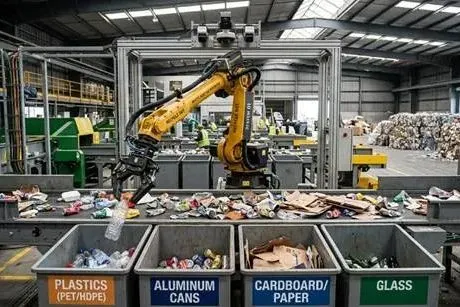
The UK government has announced the establishment of the nation's first waste and recycling robotics hub. Hosted by Kingston University, the research and development centre aims to accelerate the integration of advanced automation and robotic sorting technologies across UK waste management facilities. The project is designed to address long-standing efficiency challenges in the waste sector by deploying intelligent systems capable of identifying and separating complex material streams.
For UK waste companies and packaging converters, this initiative represents a significant step toward modernising domestic infrastructure. Traditional sorting methods often struggle with high throughput and stringent purity requirements, leading to high reject rates and downgraded material values. By introducing automated robotic systems, facilities can achieve more precise sorting of polymer types, such as separating food-contact PET from non-food packaging, which is critical for meeting domestic recycling targets and circular economy goals.
This technological shift has direct implications for the UK–Türkiye plastics trade. Turkish recyclers rely heavily on high-quality, low-contamination plastic feedstock imported from the UK. As UK sorting facilities adopt automated robotics, the quality of exported bales—particularly HDPE, LDPE, and PP—is expected to improve significantly. Cleaner feedstock reduces processing costs for Turkish importers, lowers the risk of customs rejections under Annex VII regulations, and helps Turkish processors meet strict European quality standards for recycled resins.
A practical takeaway for UK waste operators is to begin auditing their current sorting lines for automation compatibility. While widespread adoption of these robotic systems will take time, early engagement with emerging hub research will help businesses plan capital expenditure for future facility upgrades, ensuring they remain competitive as international purity standards tighten.