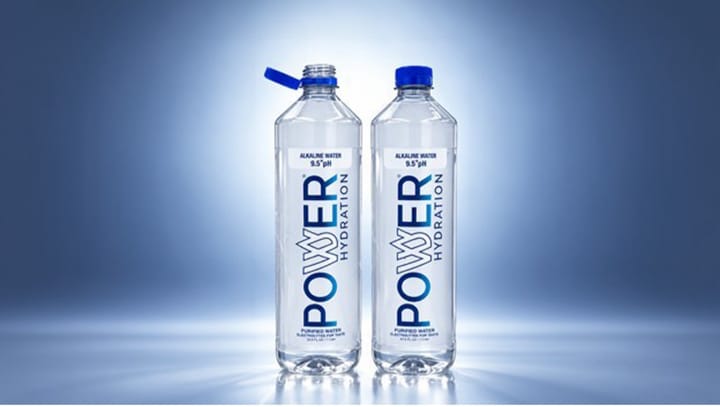
US beverage producer Power Hydration has introduced a 1-litre bottle featuring Closure Systems International’s (CSI) Twist & Flip tethered closure, paired with a container manufactured entirely from 100% recycled PET (rPET). The deployment represents one of the earliest commercial rollouts of tethered cap technology in North America, a packaging design shift previously driven almost exclusively by European regulatory mandates.
Why it matters
The adoption of tethered closures outside the European Union signals a growing international convergence towards circular packaging design standards. Under the EU Single-Use Plastics Directive, single-use plastic beverage containers must feature attached caps to reduce small-format litter and ensure closures remain attached through collection and recovery channels.
Combining a tethered closure with a 100% rPET bottle demonstrates that cap-retention mechanisms can be integrated into large-format beverage lines without sacrificing bottling line efficiency or material performance. From a circular economy perspective, tethered closures significantly improve the recovery rate of high-density polyethylene (HDPE) and polypropylene (PP) caps, preventing small components from being lost in municipal sorting operations or entering terrestrial and marine environments.
Implication for UK–Türkiye recycling supply chains
For UK waste management companies, packaging converters, and Turkish PET recyclers, the global rollout of tethered closures reinforces the necessity of aligning design formats with automated sorting infrastructure. As attached closures become the default format across international markets, the proportion of polyolefin caps arriving at reprocessing facilities attached to PET bottles will rise sharply.
Turkish recyclers processing post-consumer PET bottles must ensure their automated granulating and sink-float separation systems are calibrated to handle higher volumes of attached polyolefin caps efficiently. Because polyolefins float while PET sinks in water medium separation, precise processing yields high-purity rPET flakes alongside a cleaner, secondary HDPE/PP stream. For UK packaging converters, designing for tethered caps ensures compliance with evolving UK and European circular design guidelines while maintaining interoperability across export markets.
Practical takeaway
Packaging converters and brand owners should audit bottle-and-closure material combinations to ensure full compatibility with mechanical wash-and-separate recycling systems, verifying that cap attachment mechanisms do not contaminate main PET streams during reprocessing.