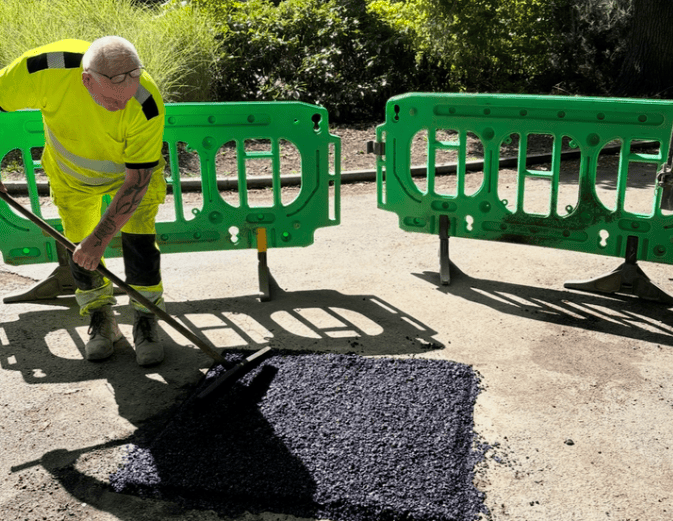
Maidstone Borough Council has commenced trials of an innovative pothole repair material formulated from recycled textile waste. Partnering with sustainable materials specialist RECOOL, the local authority is testing the composite mixture on council-owned land, specifically within Mote Park and Penenden Heath. The pilot aims to assess the durability of the textile-infused material in non-highway settings before considering wider applications.
This trial reflects a growing momentum within UK local government to find high-value, secondary uses for problematic municipal waste streams. Rather than relying on traditional asphalt or sending post-consumer textiles to landfill or incineration, the project explores how fibrous waste can reinforce infrastructure materials.
For UK waste management companies and recyclers, this development highlights a shifting landscape in municipal procurement. Local authorities are under intensifying pressure to meet net-zero targets and demonstrate localised circular economy initiatives. Consequently, waste operators who can process complex, mixed-material streams—or partner with innovative material science firms—will be better positioned to secure municipal contracts. Furthermore, the integration of synthetic fibres (often polyester-based) into construction materials mirrors parallel developments in the polymer sector, where mixed plastic fractions are increasingly trialled in asphalt and concrete.
For Turkish recyclers exporting to or operating within European supply chains, these trials underscore the long-term trend toward cross-sector circularity. As carbon reporting and Scope 3 emissions tracking become more stringent, the ability to divert synthetic waste from energy-from-waste facilities into long-term infrastructure storage will become a key metric for carbon-conscious partners.
The practical takeaway for the sector is clear: municipal waste management is moving beyond simple segregation and export. To remain competitive, waste firms must actively explore partnerships that convert low-grade municipal fractions into functional, industrial-grade raw materials.