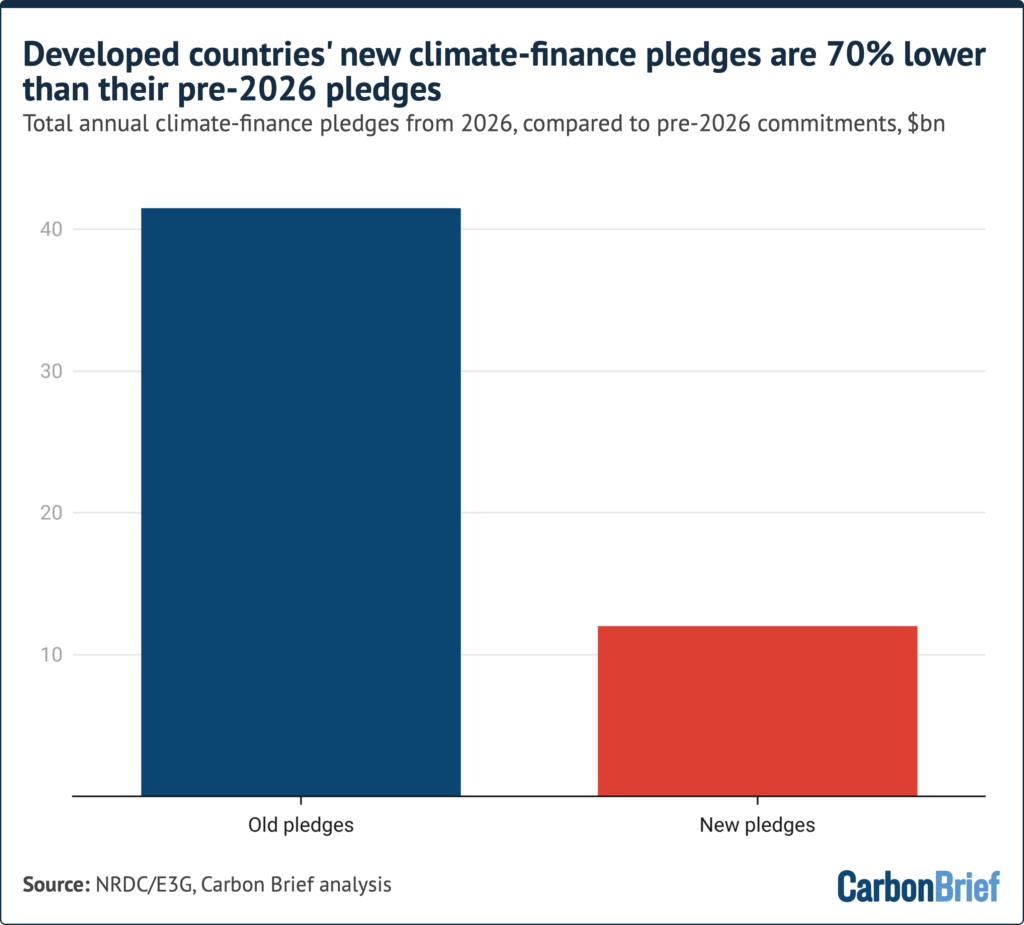
An analysis of international climate funding reveals a 70 per cent decline in public financial pledges as national delegates gather for global climate negotiations. The sharp contraction highlights growing fiscal constraints among industrialised economies and signals a retreat from state-led international decarbonisation funding.
What happened
Recent tracking compiled by Carbon Brief demonstrates that sovereign commitments aimed at helping developing nations tackle climate mitigation and adaptation have fallen dramatically. The decrease reflects tight domestic budgets, shifting political priorities across major Western economies, and broader macroeconomic headwinds. While multilateral climate frameworks continue to call for urgent reductions in global greenhouse gas emissions, the direct flow of public concessionary finance has slowed significantly.
Why it matters
The reduction in public climate finance shifts the burden of funding environmental transition initiatives onto private capital markets and domestic regulatory frameworks. As governments curb direct international subsidies, policy focus is concentrating on legislative instruments—such as packaging taxes, extended producer responsibility (EPR) schemes, and mandatory recycled content quotas—to force industrial decarbonisation.
Simultaneously, financial institutions and corporate buyers are enforcing stricter ESG standards across their international supply chains. With public transition funds constrained, industrial operators must demonstrate verifiable carbon reductions to secure commercial contracts and access private growth capital.
Implications for UK and Turkish recyclers
For waste management companies in the UK and plastics reprocessors in Türkiye, the retreat of public climate funding emphasises that market-driven compliance and regulatory mandates will dictate the circular economy landscape. UK packaging converters and Turkish polymer recyclers cannot count on state subsidies to underwrite decarbonisation efforts. Instead, success hinges on robust carbon accounting, precise lifecycle assessments (LCAs), and transparent supply chain reporting. Demonstrating lower embodied carbon in recycled polymers compared to virgin resins remains the strongest commercial driver in the UK-Türkiye trade corridor.
Practical takeaway
Plastics recyclers and converters should focus on standardising their Scope 1, 2, and 3 carbon data rather than anticipating new government grant programmes. Establishing verified carbon metrics will safeguard export contracts and ensure access to ESG-linked commercial financing.