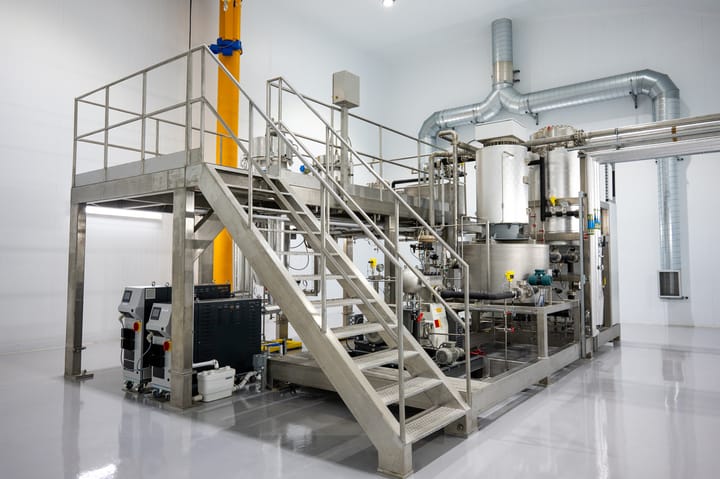
The COtooCLEAN project, developed by technology developer Nextek alongside packaging producer Coveris, has received the Packaging Recycling Project of the Year award. The initiative uses commercially scalable supercritical carbon dioxide ($scCO_2$) to decontaminate post-consumer polyolefin films, returning flexible packaging materials like polyethylene and polypropylene back to food-contact quality standards.
Flexible packaging has long presented a major technical hurdle for mechanical recyclers. Traditional washing and extrusion systems frequently fail to remove deeply embedded odourants and chemical contaminants from post-consumer flexible films to the levels required by British and European food safety authorities. Consequently, the vast majority of recycled flexible plastics are downgraded into low-value industrial applications or diverted to energy recovery.
The COtooCLEAN process addresses this limitation by using supercritical carbon dioxide as a cleaning agent. Under elevated pressure and temperature, carbon dioxide acts as a solvent, penetrating polyolefin matrix structures to strip out oils, inks, and volatile organic compounds without degrading the underlying polymer chains. The process operates with a lower energy footprint compared to solvent-based extraction or thermal pyrolysis, directly aligning with industrial carbon abatement goals.
What it means for UK and Turkish operators
For UK packaging converters and Turkish recycling plants, the commercial maturation of food-grade flexible recycling technology marks a shift in feedstock valuation. As regulatory frameworks such as the UK Plastic Packaging Tax (PPT) and prospective EU packaging directives demand higher post-consumer recycled (PCR) content in primary packaging, converters face growing pressure to secure compliant, high-purity resins.
Turkish recyclers supplying European supply chains should monitor the commercial rollout of $scCO_2$ decontamination units, as these systems will require consistently sorted post-consumer film feedstocks. Furthermore, adopting low-emission decontamination technologies will help recyclers satisfy Scope 1 and Scope 2 carbon reporting demands, ensuring that processed polyolefins retain both regulatory compliance and a lower embodied-carbon profile in export markets.
Practical takeaway
Converters and reprocessors should audit their flexible film feedstock streams today. Upgrading optical sorting capabilities to isolate mono-material polyolefin films will position businesses to capture higher-margin food-grade PCR markets as $scCO_2$ decontamination systems achieve wider commercial deployment.