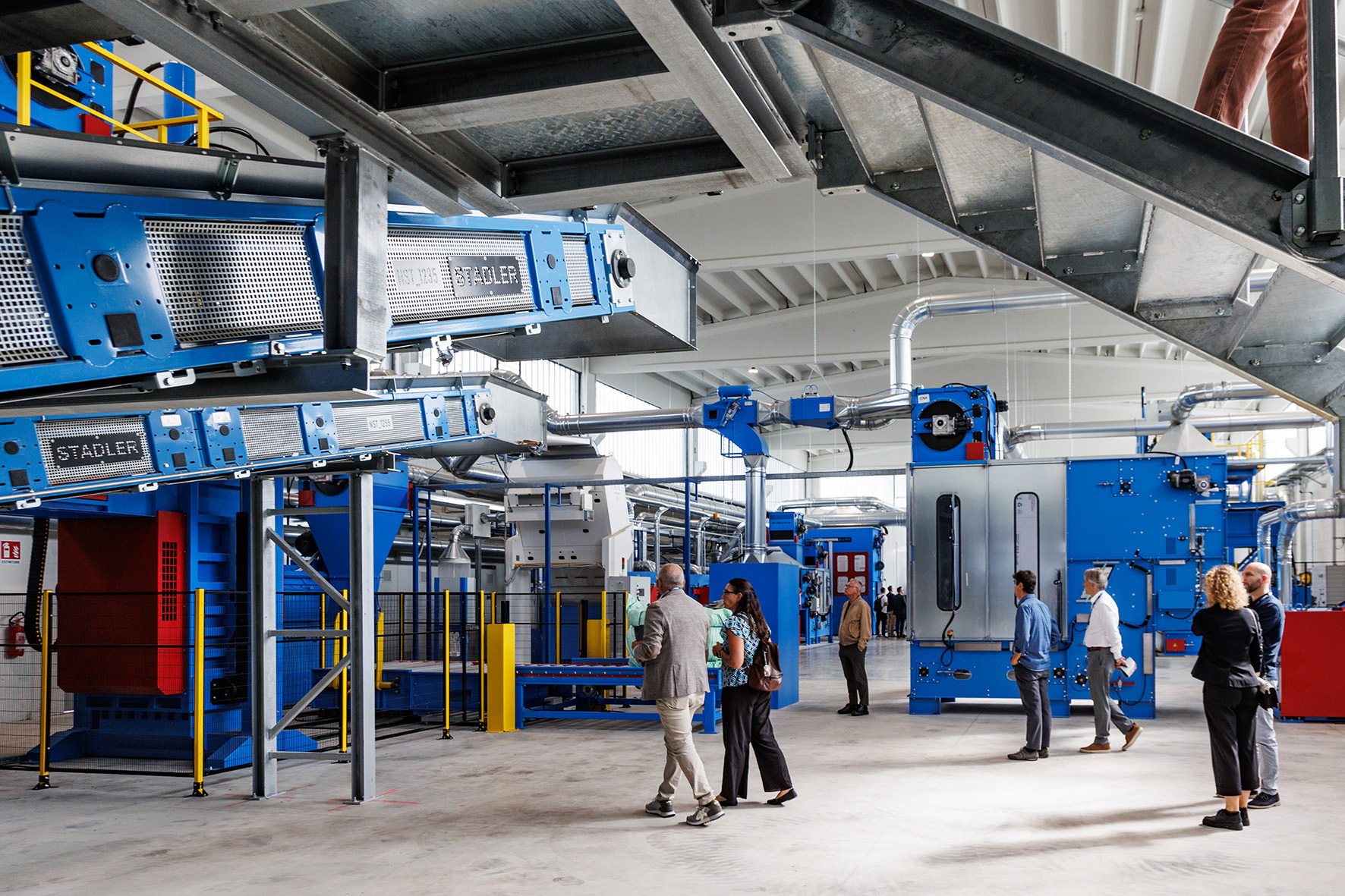
Italy has commissioned its first fully integrated textile waste treatment facility in San Pietro Mosezzo. Developed through a partnership between IGERS and sensor-based sorting manufacturer STADLER, the plant unifies automated near-infrared (NIR) sorting with mechanical regeneration. The facility processes both post-industrial and post-consumer textile waste into high-purity fibres suitable for respinning into new yarns.
Historically, mechanical textile recycling has faced severe bottlenecks due to material contamination, elastane blends, and complex fibre composition. These limitations frequently forced operators to downcycle mixed waste into low-value applications like industrial wipers or building insulation. By incorporating multi-sensor optical sorting, the new site separates distinct polymer and natural fibre streams—including synthetic fractions such as polyester—with high precision, establishing an operational pathway toward high-grade closed-loop circularity.
For UK waste management companies and Turkish plastics and fiber recyclers, the development offers valuable technical insights. Synthetic textile waste share common polymer backbones with PET packaging streams, and the push towards mandatory textile collection across Europe will generate large, complex waste volumes requiring sensor-based separation. Turkish reprocessing hubs, which process significant volumes of European feedstocks, will increasingly require high-purity inputs to meet incoming eco-design rules and maintain supply chain compliance. Adopting mechanical sorting systems designed for complex waste matrices provides a lower-carbon alternative to chemical processing, helping recyclers trim scope 1 and 2 emissions in audit reporting.
Practical Takeaway: Waste operators and material processors should assess NIR sorting investments to capture purified synthetic and natural fractions. Upstream mechanical separation remains the most carbon-efficient method to meet European secondary raw material purity standards.